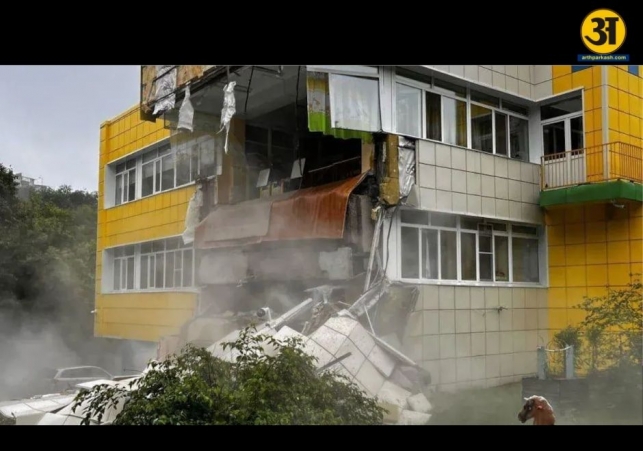
Tsunami hits Russia after 8.8 quake; US, Japan on alert
Tsunami hits Russia after massive 8.8 magnitude earthquake strikes Kamchatka; US and Japan on alert
A very powerful earthquake hit Russia’s Kamchatka Peninsula early on Wednesday, causing a tsunami and sending alerts to several countries including the United States and Japan. The quake had a magnitude of 8.8 according to Japan’s weather agency. The earthquake caused tsunami waves of 3 to 4 meters in some areas of Kamchatka. Authorities in Russia, Japan, and the US quickly issued tsunami warnings.
According to Japan’s Meteorological Agency, the earthquake occurred at 8:25 am (local time) and had an initial reading of 8.0 magnitude. The waves were expected to hit Japan’s northern coast, especially Hokkaido, and could reach up to 1 meter in height. Fortunately, there have been no reports of damage in Japan so far, and the shaking was felt only slightly.
The United States Geological Survey (USGS) reported that the earthquake had a depth of 19.3 kilometers and was located in the Pacific Ocean. The epicenter was around 250 kilometers away from Hokkaido, the northernmost of Japan’s four main islands. Later, the USGS updated the magnitude to 8.7.
News agencies also reported that a tsunami had reached the Kuril Islands of Russia and Japan’s Hokkaido. Hawaii, too, was put on alert and sirens were heard in Honolulu. Residents were asked to move to higher ground as a safety measure. Even though the tsunami has not caused major damage yet, emergency teams remain on high alert.
Tsunami warnings for Pacific countries and US coastline
Following the earthquake, tsunami warnings were issued by several authorities. Russia’s emergency department confirmed that waves as high as 3 to 4 meters were seen along the Kamchatka coast. These waves could be dangerous for those living near the shore.
The US National Tsunami Warning Center in Alaska issued a tsunami warning for the Aleutian Islands and a watch for the US West Coast including California, Oregon, Washington, and Hawaii. A large portion of Alaska’s coastline was also included in the alert.
Former US President Donald Trump posted on X (formerly Twitter) to inform citizens about the tsunami warning. He said that a “massive earthquake” in the Pacific Ocean had triggered the warning and urged everyone to stay alert and visit the official tsunami website for updates.
In Japan, authorities also stayed cautious. A seismologist from the University of Tokyo, Shinichi Sakai, said that even earthquakes far from Japan can cause a tsunami if they are shallow. Japan’s coast guards and weather officials are closely watching the ocean to monitor wave movements.
ALSO READ: HIV-positive Indians rewrite their story — from survival to celebration
Japan’s long history of earthquakes
Japan is located on the “Ring of Fire,” an area around the Pacific Ocean where earthquakes and volcanic eruptions are common. The country experiences many earthquakes each year. Although most are small, larger ones can lead to dangerous tsunamis.
Just earlier in July, five earthquakes shook the sea near Kamchatka. The largest among them had a magnitude of 7.4. That quake occurred 144 kilometers east of Petropavlovsk-Kamchatsky, a city in Kamchatka with about 180,000 people. That earlier series of quakes had not caused any serious damage, but scientists had already started watching the area more closely.
Historically, Kamchatka has seen strong earthquakes. On November 4, 1952, a very powerful quake of magnitude 9.0 hit the region. That event triggered huge waves — up to 9.1 meters high — in Hawaii. Thankfully, even then, there were no deaths reported. However, it caused widespread damage.
Today, authorities are better prepared for such natural disasters. They now use modern warning systems and better safety plans to reduce the risks. For example, sirens in Hawaii and alerts in Japan are part of those preparations. Still, earthquakes of such strong magnitude always bring fear and concern.
Current situation and future precautions
At the moment, no major destruction has been reported from Kamchatka or nearby areas. However, emergency officials in Russia are still checking coastal towns and villages for possible damage or injuries. In the US, especially Hawaii and Alaska, authorities are continuing to monitor ocean waves.
People living in coastal areas are being asked to stay away from beaches and move to higher ground if possible. Schools and offices in some parts of Japan and Russia have been temporarily shut down as a precaution. The situation remains serious until the tsunami threat fully passes.
Seismologists believe that the Pacific region must always be ready for such events. Countries like Japan, the US, and Russia hold regular drills and have early warning systems. Even though today's earthquake did not cause heavy damage, it is a reminder that nature can strike without warning.
It also shows how connected the world is — an earthquake in Russia can send waves across the Pacific and affect countries thousands of kilometers away. Staying alert, listening to official updates, and following safety advice are the best ways to stay safe during such natural disasters.
Related News